City of Donald, Oregon
History of Donald, Oregon
Established 1912
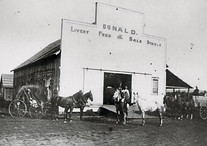
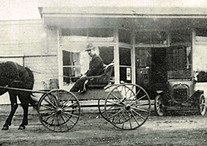
Donald Livery, Feed
& Sales Stable
The Oregon Country was the region between the Rocky Mountains and the Pacific Ocean and was originally inhabited by the Kalapuyan people. In the early 1800s, fur trading companies such as the Pacific Fur Company and the North West Company explored and trapped throughout the Willamette and Columbia River valleys. Many of these trappers were French Canadian and later settled in the area that became known as French Prairie.
The town of Donald developed from portions of two early land claims. Claim 61, belonging to Willard H. Rees, consisted of 640.67 acres, while Claim 62, owned by Gustavus A. Cone, totaled 673.31 acres.
Other early pioneers in the Donald area included Francis X. Matthieu, William Whitney, St. M. Fackler, James E. Hall, and William M. Case.
Gustavus A. Cone
Gustavus A. Cone was an early pioneer known for his strong character and contributions to the local community. He owned 640 acres of land, where he raised grain and general crops and devoted much of his time to breeding Shorthorn cattle and other high-quality livestock.
In addition to farming, Cone was involved in business, operating a general mercantile store in Butteville with his eldest son, Benjamin F. Cone. He also played a key role in establishing the Farmer’s Warehouse Association.
Cone remained active in the community throughout his life, serving in several positions of trust and participating in local civic and political affairs.
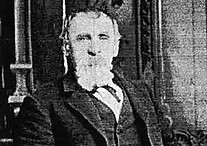
Gustavus A. Cone

Gustavus A. Cone House

Francis Xavier Matthiew
Francis Xavier Matthieu
Francis Xavier Matthieu was a French Canadian pioneer and an important figure in early Oregon history. He was one of the 52 settlers who voted in 1843 to establish the Provisional Government of Oregon and was later recognized as the last surviving voter from that decision.
Matthieu settled on French Prairie and founded the town of Butteville, where he operated a general merchandise business. He later claimed 640 acres of land nearby, first under the provisional system and then as a Donation Land Claim in 1850. He also served as the area’s first postmaster and was active in the Oregon Pioneer Association.
He died on February 4, 1914, in Butteville. Matthieu Street in Donald is named in his honor
Construction of Donald
Substation 1906
Oregon Electric Railway
Donald has a rich history in agriculture, industry, and business. Between approximately 1840 and 1860, the area was settled by farmers and loggers from the Midwest, and by the early 1900s it had become a main station along the Oregon Electric Railway. The town was named after R. L. Donald, an engineer with the construction company that built the railway, and it developed from Donation Land Claims later sold to the Donald Town Lot and Land Company in 1908. The community was originally centered around agriculture, with hops as a major crop.
The Oregon Electric Railway established a substation in Donald in 1906, along with a depot connecting Salem and Portland. The completion of Highway 99E reduced railway ridership, and the last electric railway ran through Donald on May 14, 1933, after which the population declined from about 300 to around 100. The railway later transitioned to steam and diesel and became part of Burlington Northern in 1981, and the line remains in use today.

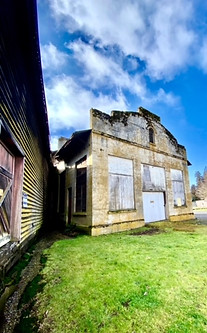
Donald Substation still
stands today
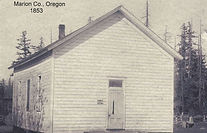
Donald's 1st Schoolhouse
1867-1911
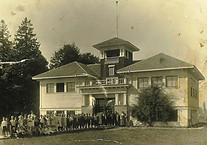
North Marion School District
Schools in Donald were part of District No. 1 in Marion County for 108 years, from 1853 to 1961.
The first schoolhouse was built in 1853 for a cost of $200 and served the community until 1911. A second schoolhouse, later known as the Donald Grade School, was built in 1911 and located on the southwest corner of Butteville Road and Yergen Road. This building burned down in 1938. While a new school was being built, classes were held at the Methodist Church.
A third school was constructed on the same site between 1938 and 1939. It remained in use until 1961, when the school merged with North Marion School District. This building is still in use today and is now home to Bear Electric, an electrical contractor.
Today, the N. Marion School District spans both sides of Grim Road and includes the district offices, primary school, junior high, and high school.
Donald's 2nd Schoolhouse
1911-1938
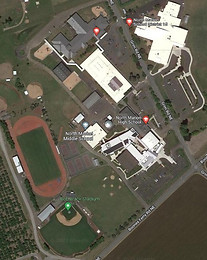
North Marion School District today
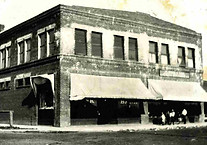
Hoskins and DeSart building. Now the Center Market
Historical Businesses
What we now know as the Donald Tavern was originally the Mays, Carver and Groff Store in 1903. The business later moved into the Hoskins and DeSart Building, and the original building became the Marty Saloon.
The Hoskins and DeSart Building, which is currently the Center Market, once housed several early businesses. Half of the building was occupied by J. L. Busick, a flour and seed business, while the other half contained the general merchandise store operated by Mays, Carver and Groff.
During this same period, the town continued to develop as a small commercial and agricultural hub. The Donald post office was established on April 13, 1910, and the town was also home to the Donald Brick and Tile Works from 1911 to 1923.
The local agricultural cooperative that later became associated with Wilco operated in Donald for many years. It began as a feed and seed cleaning facility and, over time, became part of the regional cooperative system. This site was historically an important seed processing location and was once the largest grass seed cleaning facility in the state, processing millions of pounds of seed annually, and is now occupied by Valley Ag.
Marty, Carver & Groff store. Now the Donald Tavern
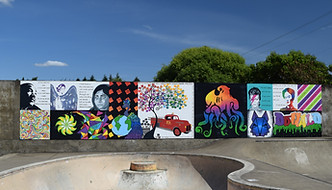
The Donald Skate Park
From a simple asphalt slab and homemade ramps to Oregon’s first public skate pool, Donald’s skate park is a story of initiative and community pride.
It began when a group of local kids approached the Mayor at the time with the idea of creating a place to skateboard. With the City’s support, they were given space to build, and they spent months designing and constructing their own skate features.
That early effort laid the groundwork for something bigger. In 2001, the City secured state grant funding to build a permanent, all-concrete skate park. Constructed by Dreamland in less than a month, the park became a unique feature for the community and a destination that draws visitors from all over, including Australia, England, Japan, California, and Washington.
Today, the skate park stands as a lasting example of what can happen when local ideas, hard work, and community support come together.
The group who helped bring this project to life includes: Chris Besabe, Justin Brant, Lacy Marrow, David Trumps, Ian Merrick, Adam Chapman, Josh Swain, Colin Hill, Jacob Taylor, Colt Powell, Charlie Ballew, Bjorn Day, Bea Powell, Dan Spotanski, Kasey Spotanski, Tyler Fryman, Donavan Bryce, Jesse Cunnally, Jason and Jarrod Harman, and Ty Ervast.